
In Philadelphia’s Fishtown neighborhood, where music spills from venues and street performers animate summer sidewalks, a mural titled “Just Like Music” rises along East Allen Street. Painted in late 2022 by Faysal Adger, who is now 20, the work reflects the city’s rhythms: music, nature, community, and history coming together on a single wall.
A Black woman stands, surrounded by stylized flowers, with a cityscape in the background. The cityscape and skyline are rendered in blue hues while the flowers and the woman’s dress feature varying vibrant colors. Birds and music notes circle and land on the woman. She stands next to a tall sunflower.
Created through the Philadelphia Fellowship for Black Artists, the mural is near the music venues that shape the neighborhood’s cultural identity. For Adger, the location felt fitting. His concept began with a simple idea about the power of shared experience.
“I was really into nature and community and I wanted to give back to the community,” Adger says, reflecting on what he was thinking when conceiving the work. “I also love how music can bring people together and art can bring people together.”
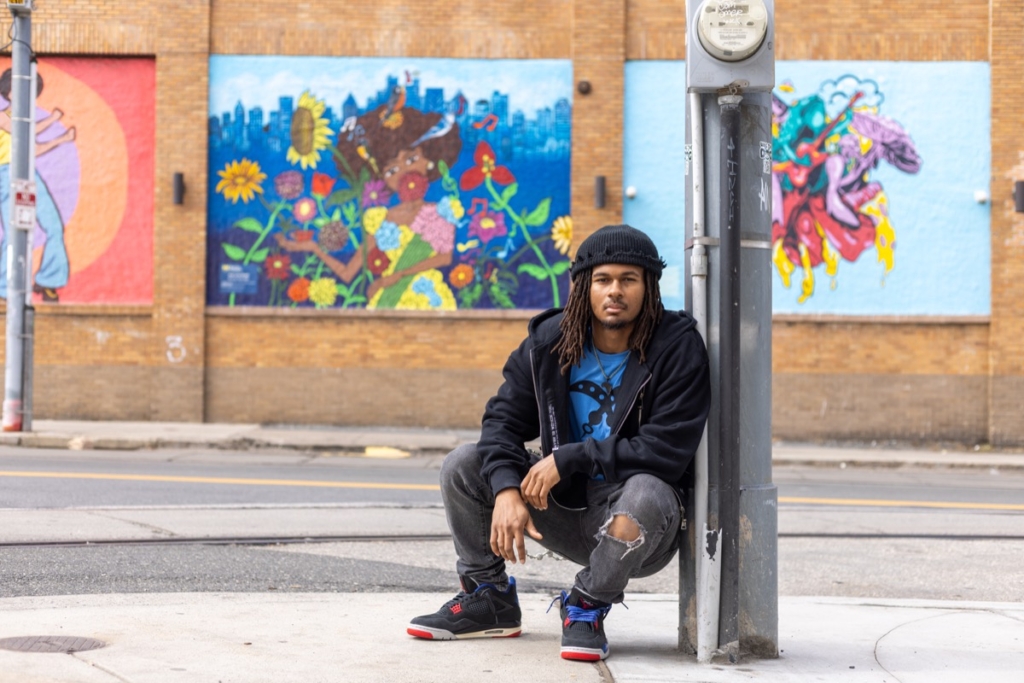
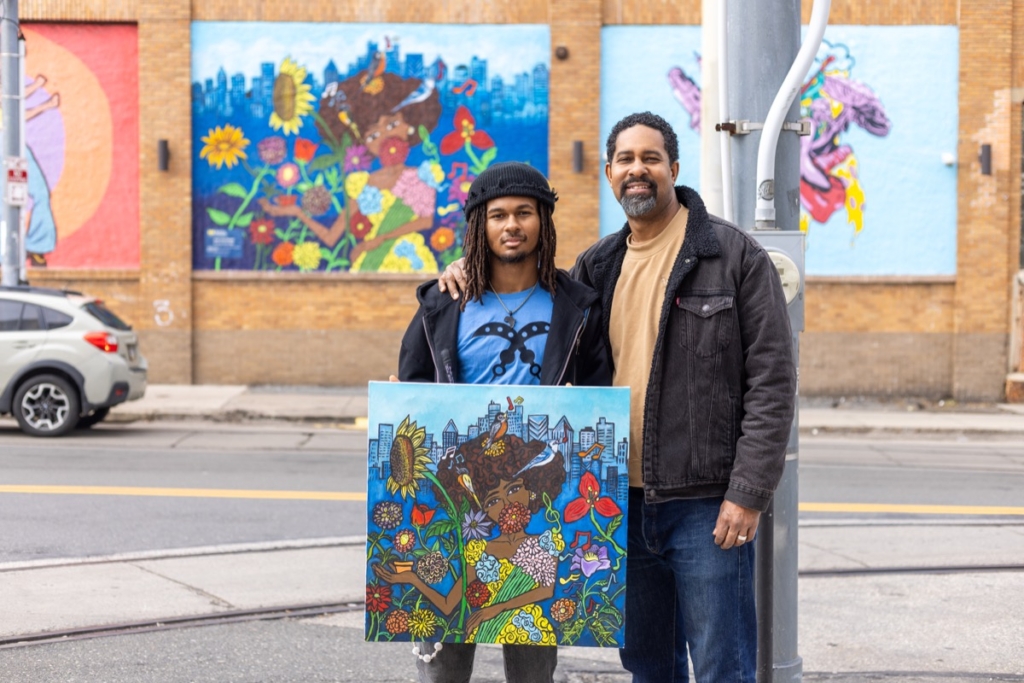
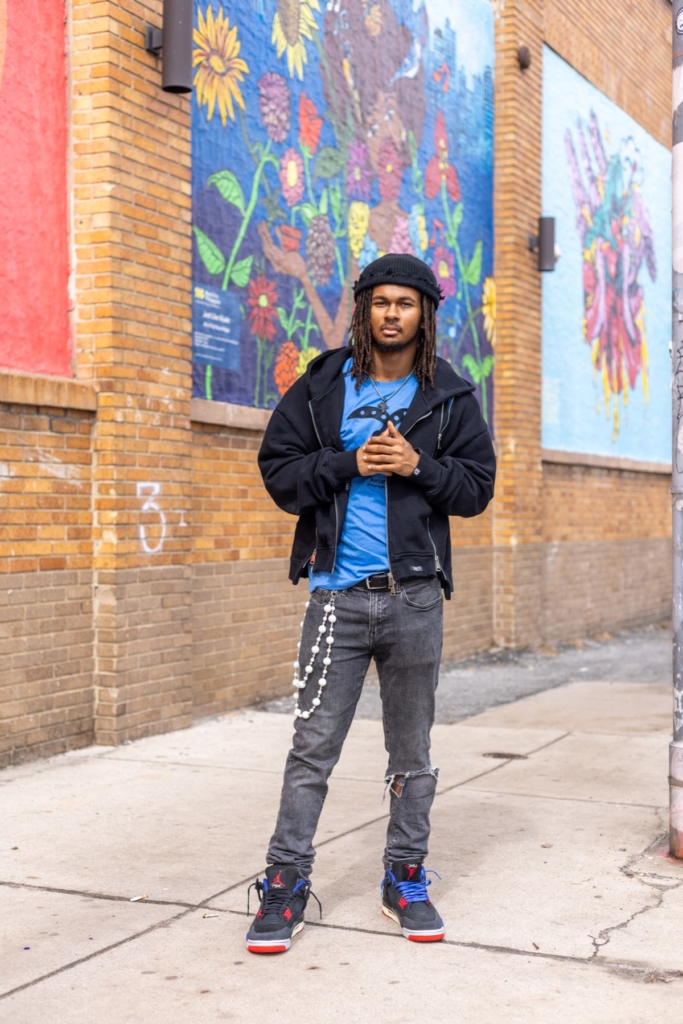
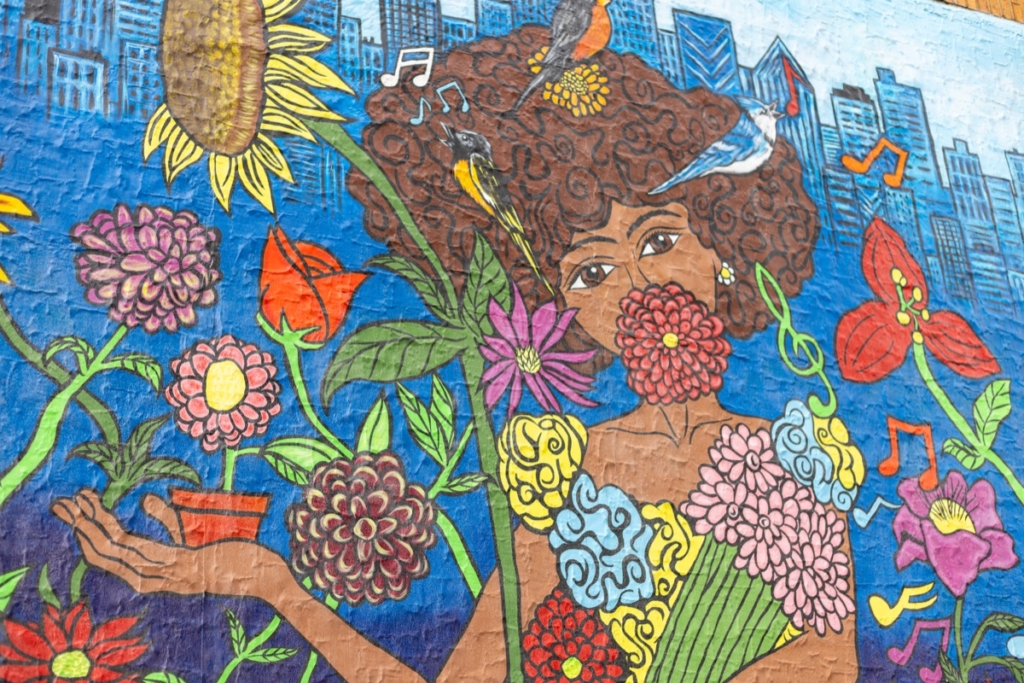
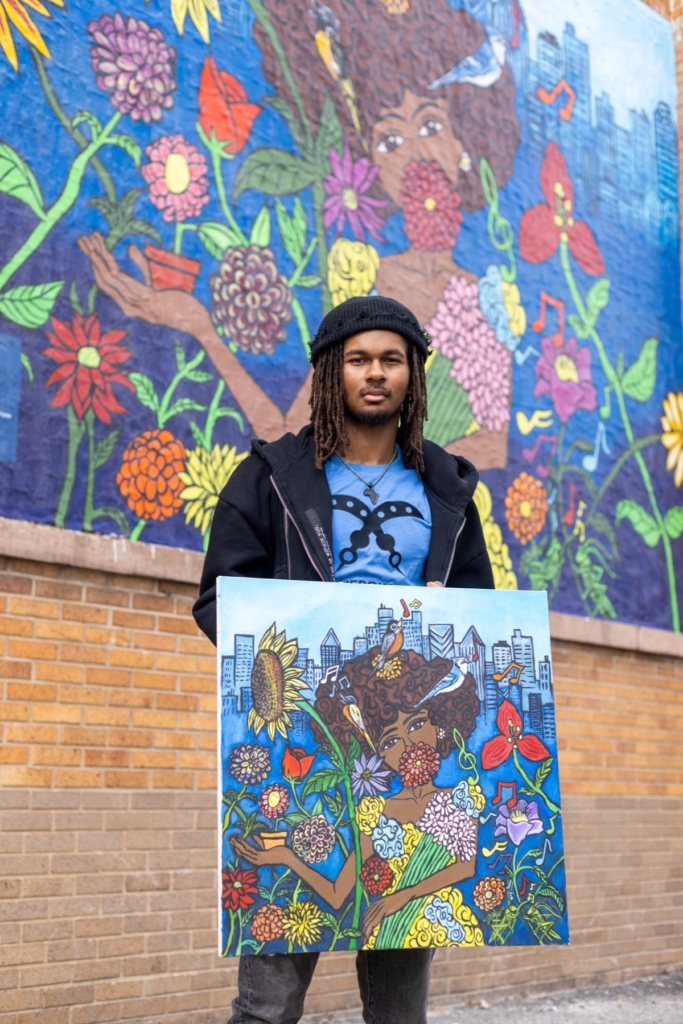
“I love African masks,” Faysal Adgar ex- plains of his influences for his “Just Like Music” mural. “I have this one mask from the Igbo tribe, and I tried to make her dress resemble that a little bit — the pat- terns on her dress. And I thought that was a nice touch.”
The mural’s imagery mirrors that convergence. The woman appears surrounded by flowers, with elements of the city around her — nature and urban life intertwined. The composition echoes Philadelphia itself, a place where green spaces, rowhomes, and music-filled streets coexist.
Adger also looked closely at the everyday sounds and rituals of the city while designing the piece. Street music in particular became a guiding inspiration.
While creating “Just Like Music,” Adger thought about how during the summertime, you can see drummers drumming around Philadelphia.
The visual language of “Just Like Music” also carries influences from beyond the city.
“I love African masks,” he explains. “I have this one mask from the Igbo tribe, and I tried to make her dress resemble that a little bit, the patterns on her dress. And I thought that was a nice touch.”
Adger draws inspiration from African art and design, particularly masks and patterns that connect him to a deeper cultural history. But influence comes from many places — history, observation, family guidance, and curiosity about the wider world.
“My dad tells me to brainstorm,” Adger says, noting his dad is an art teacher. “So I brainstorm. I look at poses on Google and stuff, and I look at nature around me.
“Sometimes I would just go outside, walk around, or look up places around the world and see inspiration.”
Though still early in his career, Adger has already completed several public art projects. Among them are a collaborative mural created with his father, Khaleel, and brother, Faruq, titled “Once Upon a Time in Germantown” and a mural at the School of the Future exploring economic growth. “Just Like Music” marks one of his most prominent public works so far.
Portraiture appears frequently in his art. For Adger, depicting human figures allows him to explore imagination and possibility.
“I feel like making things seem not real a little bit [makes] people more interested,” he says. “When you’re making art, you’re your own destiny. When you are making art… you’re your own God, you’re creating something new.”
That sense of creation is deeply tied to family lineage and ancestral memory. Adger speaks about art as something passed down through generations.
“Well, I channel it through my ancestors,” he says. “My mom and dad always used to say, ‘Channel it through your ancestors and pray to God.’”
He traces that creative inheritance to relatives who shaped his understanding of craft and perseverance. His great-grandfather, he explains, worked as a carpenter and owned a furniture store in Philadelphia.
“I feel like some of my artistic ability came from him,” Adger says. “And I’m just so grateful for that.”
He also draws inspiration from family members who paved the way before him. One relative he often thinks about is his fifth great-uncle William Adger, who graduated from the University of Pennsylvania’s College of Arts and Sciences in 1883, becoming the first African American to do so.
“I aim to present Black identity in a way that highlights its depth, beauty, and dignity, while also engaging with its political reality,” Adger explains. “For me, creating art is not just expression, but a way of affirming that Black is powerful, complex, and undeniably beautiful.”
Adger’s perspective on life has also been shaped by a deeply personal experience: surviving brain cancer as a baby. Growing up with that story gave him a powerful sense of gratitude and urgency.
“I remember I used to think about how I could have died and I could not have been here,” he reflects. “So I try and live life to the fullest.”
Art, for him, became both a form of expression and a way to engage with the world.
“Art is like that gateway of letting me connect with myself and the world around me,” he says.
Today, Adger’s interests extend beyond painting. He is also pursuing culinary training and working in a restaurant while completing an externship, exploring another creative field that relies on discipline, craft, and sensory experience.
Food and art, he believes, share a common purpose: bringing people together.
“Food is very important,” he says. “I feel like food and art go hand-in-hand.”
In his view, both practices offer ways to create joy and unity in communities that often face hardship.
“The difference I want to make with my community is I want to bring awareness of peace and prosperity,” Adger says, noting that there seems to be a lot of violence happening now. “I feel art can do that. And I feel like food can do that.”
Standing near the music venues of Fishtown, “Just Like Music” is a visual reminder that creativity — whether through sound, paint, or a shared meal — can build connections across a city.
For Adger, that possibility is the true purpose of the work.
“When I create,” Adger says, “I am really talking about connection, how people come together, grow, and find meaning in everyday life.
“My work is my way of showing that beauty and resilience in a way people can feel, not just see.”

