
In Fishtown, a neighborhood shaped by constant change, a mural not only decorates a wall, it also holds memory. On the side of a bar near a playground, Eric Okdeh’s 2023 mural “Scenes from Fishtown” offers a dense, layered scene of underwater life, neighborhood architecture, and everyday moments, inviting viewers in. It’s a mural that rewards patience, curiosity, and repeat encounters.
The mural occupies an unusual white rectangle on the wall, a remnant of a former community movie projection space. “It’s kind of a unique shape on the wall — because it doesn’t occupy the entire wall,” Okdeh explains. Rather than fight the constraint, he embraced it, designing a composition that feels like a series of windows — glimpses into Fishtown’s past and present.
The imagery pulls from the neighborhood itself: local fish species, factories, row homes, and the silhouette of the iconic milk bottle that once defined the skyline. That detail was pulled from Okdeh’s own life. “That skyline shot was from a personal photo that I took outside our windows,” he says. For nearly a decade, his studio was in Fishtown and it was his base of operations.
That lived experience anchors the mural in authenticity. While Okdeh is now based in Philadelphia’s Chinatown, this mural marks his second major project in the neighborhood; in 2014, he completed a mosaic titled “Settlement Roots” at the Lutheran Settlement House near Frankford and Master Streets.
In “Scenes from Fishtown,” the mural’s central figure — a young boy leaning toward the fish below — faces a playground, designed to be filled with children. “This is in front of a playground, so I definitely wanted kids to identify with the mural and be taken in by it,” Okdeh says. The child’s curiosity mirrors the artist’s own hopes for the work. “It’s just a curious kid. And I hope this is a mural that’s in front of a lot of curious kids.”
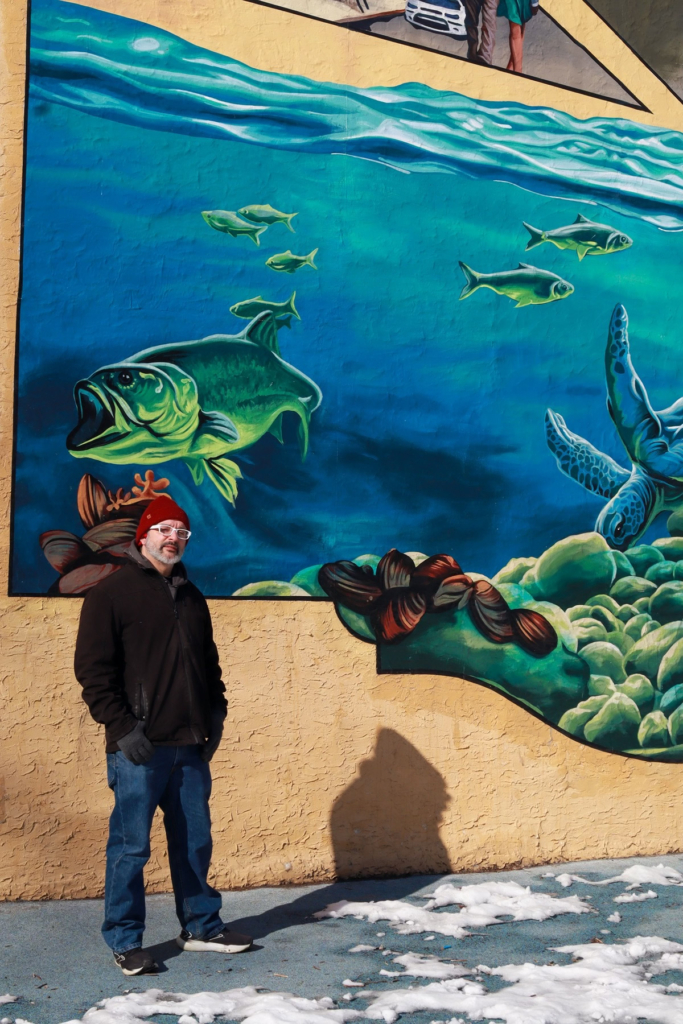
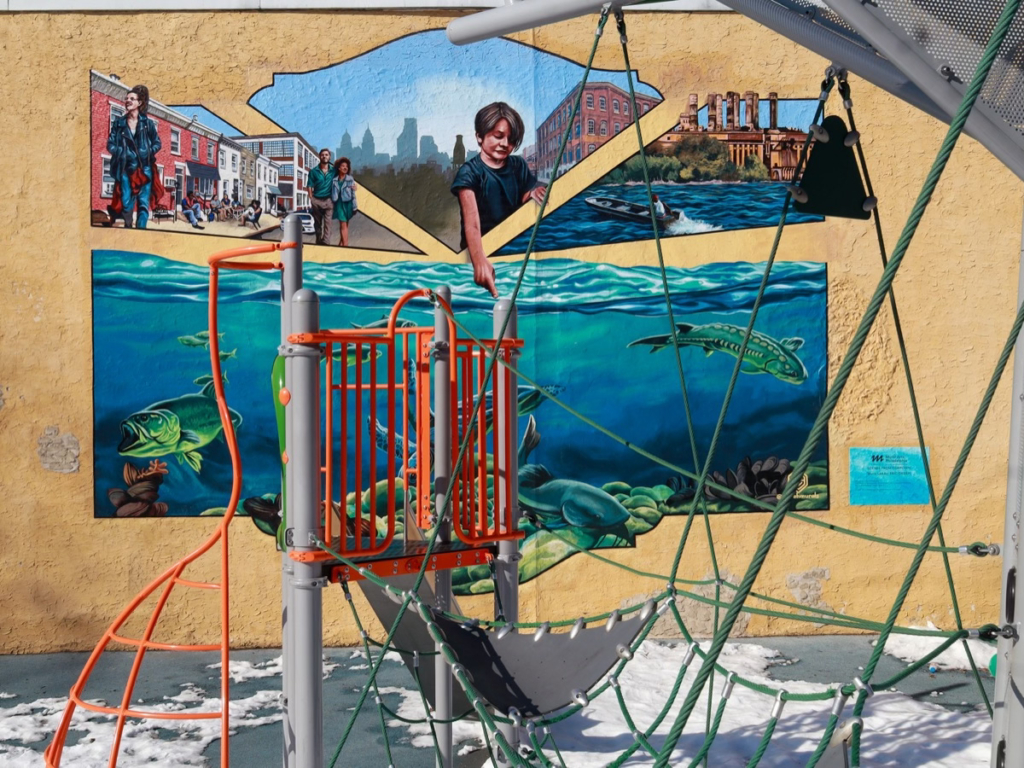
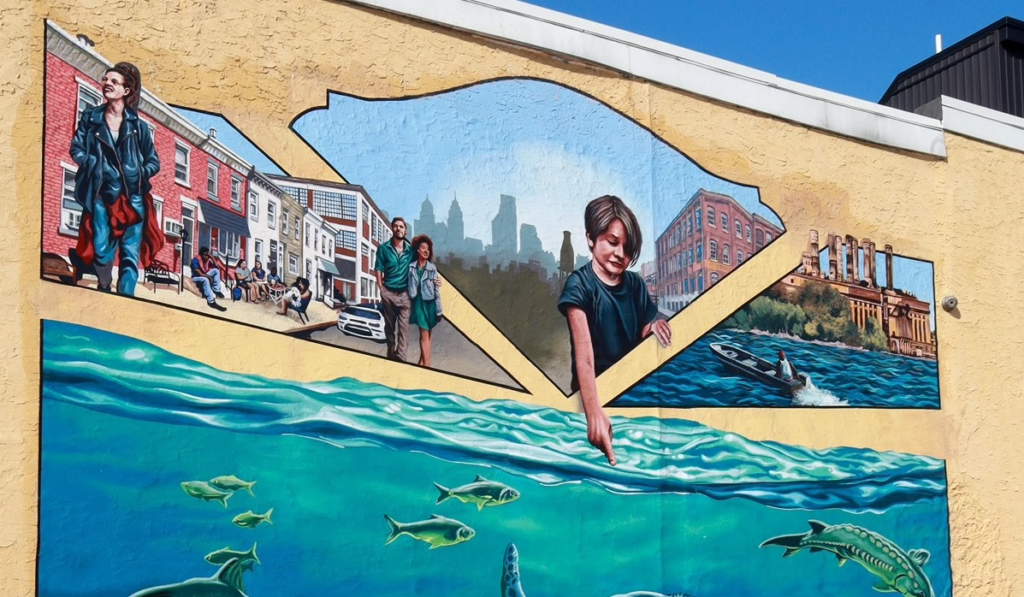
“This is in front of a playground, so I definitely wanted kids to identify with the mural and be taken in by it,” Eric Okdeh says of his 2023 mural “Scenes from Fishtown.”
While the imagery feels approachable, the philosophy behind it is layered. Okdeh describes his style as an everything-but-the-kitchen-sink approach. His murals are intentionally dense, designed to function on both a macro and micro scale. “I like that people could probably identify and see one of my projects from afar,” he says, but what matters just as much is what happens up close. “There’s elements in that design … that reward you for all the repeat viewings you’re gonna do in the lifespan of a typical mural, which could be 20 years.”
That long view is central to Okdeh’s practice — and so is community. For 28 years, he has been creating murals in Philadelphia and around the world, often through deep collaboration. He regularly works in schools, community organizations, and correctional facilities, including a long-running mural class at State Correctional Institution (SCI) Phoenix Prison, formerly SCI Graterford, a maximum-security institution for males in Pennsylvania. “The men in that group and I paint murals together and we come up with designs along with the greater community at large, depending on where we’re working,” he says.
Even when groups never meet each other, their voices intersect through the work. Describing a recent project in Kensington, Okdeh recalls working with students from Hopeworks and Jules E. Mastbaum Area Vocational/Technical School separately, and bringing design iterations back and forth between them. They develop it together, he says, and it gives the community a sense of ownership that’s hard to replicate.
Ownership, for Okdeh, doesn’t mean dictating visuals. Instead, he steers conversations toward feelings and intent. “I try not to tax them with the idea of ‘what do you want to see?’” he explains. “What I do want to hear is … what they want this mural to evoke.” Often, he says, “the reasoning behind it sometimes tells a bigger story than just a single image.”
One question he asks repeatedly is deceptively simple: What does success look like? The answers are rarely about aesthetics. “Sometimes it’s less about the actual mural … but it’s more about the intangibles of a project,” Okdeh says — how a space is used, reimagined, or emotionally transformed.
That philosophy extends to how he views public response. “You don’t really own people’s reaction to the mural,” he says. Once the work is in the world, interpretation belongs to the viewer. “People take something from the art that you never intended … Once it’s out in the public sphere, you sort of relinquish that ownership.”
In Fishtown, where development has rapidly altered the landscape, the mural becomes a quiet witness. “The Fishtown of today is almost unrecognizable from the Fishtown of 10 years ago,” Okdeh notes. Older residents may recognize buildings that no longer exist; younger viewers may see themselves reflected in the scenes of daily life.
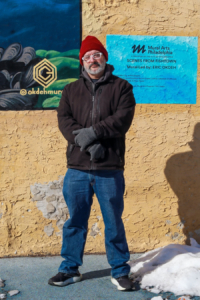
What makes Philadelphia unique, Okdeh believes, is precisely this expectation of engagement. “There is something behind most of the images that you see on walls,” he says. “It’s expected … that people are going to have some kind of say in it.” That culture of storytelling sets the city apart from street art scenes elsewhere. “You can see street art in any city,” he says, but it’s the storytelling of Philadelphia’s murals that make them really special.
After decades of work, Okdeh is increasingly aware of his place in that lineage. “I’ve had mentors coming up, and now I am a mentor to other people,” he reflects. “I won’t really grasp what I was a part of until it’s gone.”
For now, his murals remain — dense, generous, and open-ended — inviting Fishtown and its residents to keep looking, keep remembering, and keep finding themselves in the layers.


